





Meru Trek in 4 Days
Enjoy scenic trails, wildlife, and breathtaking Mount Meru views.
Maximum 6 people
Discover Mt. Meru
Discover Mount Meru via the scenic Momella Route, where lush forests, wildlife encounters,
and breathtaking mountain views make every step unforgettable.
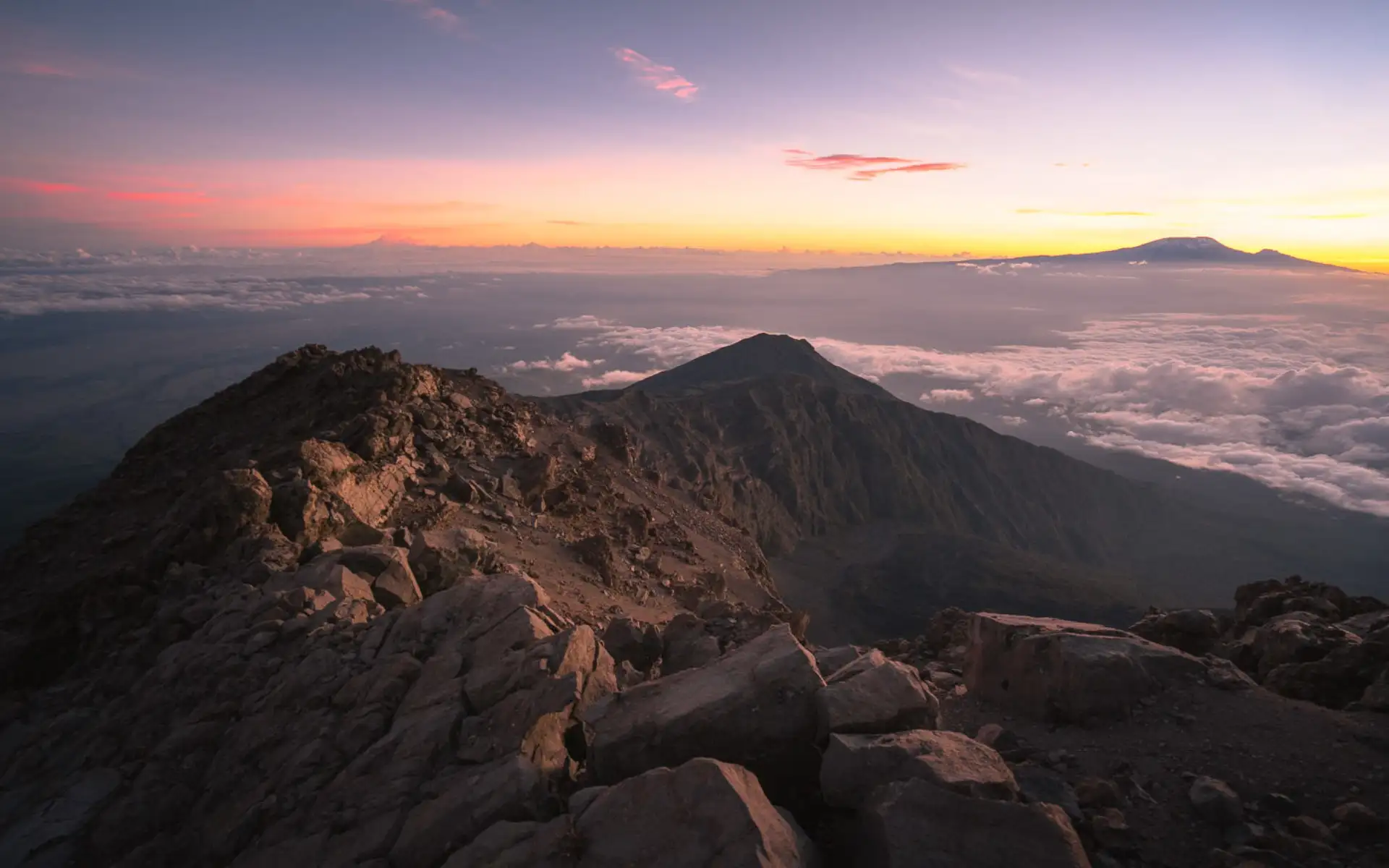
Mount Meru is Tanzania’s second highest mountain and one of Africa’s highest peaks, rising to 4,566 m (14,980 ft) inside Arusha National Park. It is a dormant stratovolcano about 70 km west of Kilimanjaro, and its Momella Route begins among grassland and forest where giraffes, buffalo, warthogs and colobus monkeys are commonly seen.
Climbing Mount Meru usually takes three or four days on the Momella Route and is suitable for fit hikers who want a high-altitude summit without a technical climb.
With Jairos Adventure, you climb with a local Arusha based team: licensed mountain guides, an armed park ranger, cooks and porters. Choose a 3 day or 4 day trek below, or read on for the route, difficulty, cost, safety and best time to climb.
Choose your route and start your summit ascent with our expert mountain guides.
Enjoy scenic trails, wildlife, and breathtaking Mount Meru views.
Maximum 6 people
Discover beautiful trails, wildlife, and stunning mountain scenery.
Maximum 6 people
Mount Meru 4-day trek (recommended)
The classic Momella Route with an extra night to acclimatize before the summit push. On the 4 day itinerary, you summit on day three, descend to Miriakamba Hut that afternoon, then walk out to Momella Gate on day four. This is the more comfortable and safer option for most trekkers.
Mount Meru 3-day trek
The same route in a compressed schedule. You still sleep at Miriakamba and Saddle Hut, but summit day becomes much longer because you continue from Saddle Hut all the way down to Momella Gate after the summit. Choose this only if you are short on time, well acclimatized and comfortable with a long, demanding final day.
The complete day by day itinerary, meals and timings are on each tour page. This is the route at a glance.
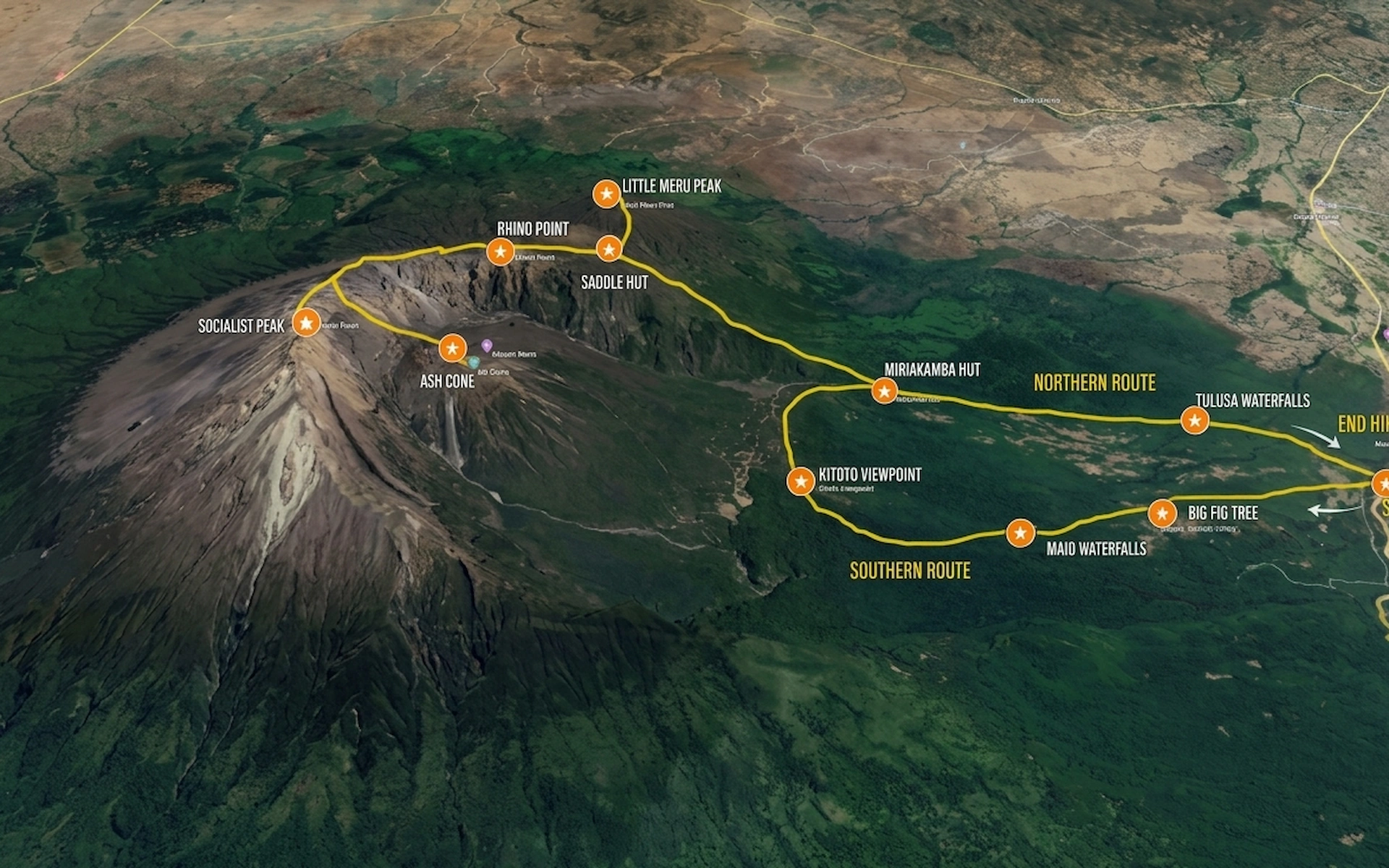
Day 1: Momella Gate to Miriakamba Hut
Start at Momella Gate, about 1,500 m, and trek through open grassland and montane forest to Miriakamba Hut at about 2,500 m. Expect roughly 4–6 hours of walking, with good chances of seeing buffalo, giraffes, warthogs, zebras and black and white colobus monkeys.
Day 2: Miriakamba Hut to Saddle Hut
Climb steadily for about 3–5 hours to Saddle Hut at about 3,570 m, passing through forest, giant heather and moorland. On the 4 day trek, take an afternoon acclimatization hike toward Little Meru, around 3,800 m, before returning to Saddle Hut for an early night.
Day 3: Summit day
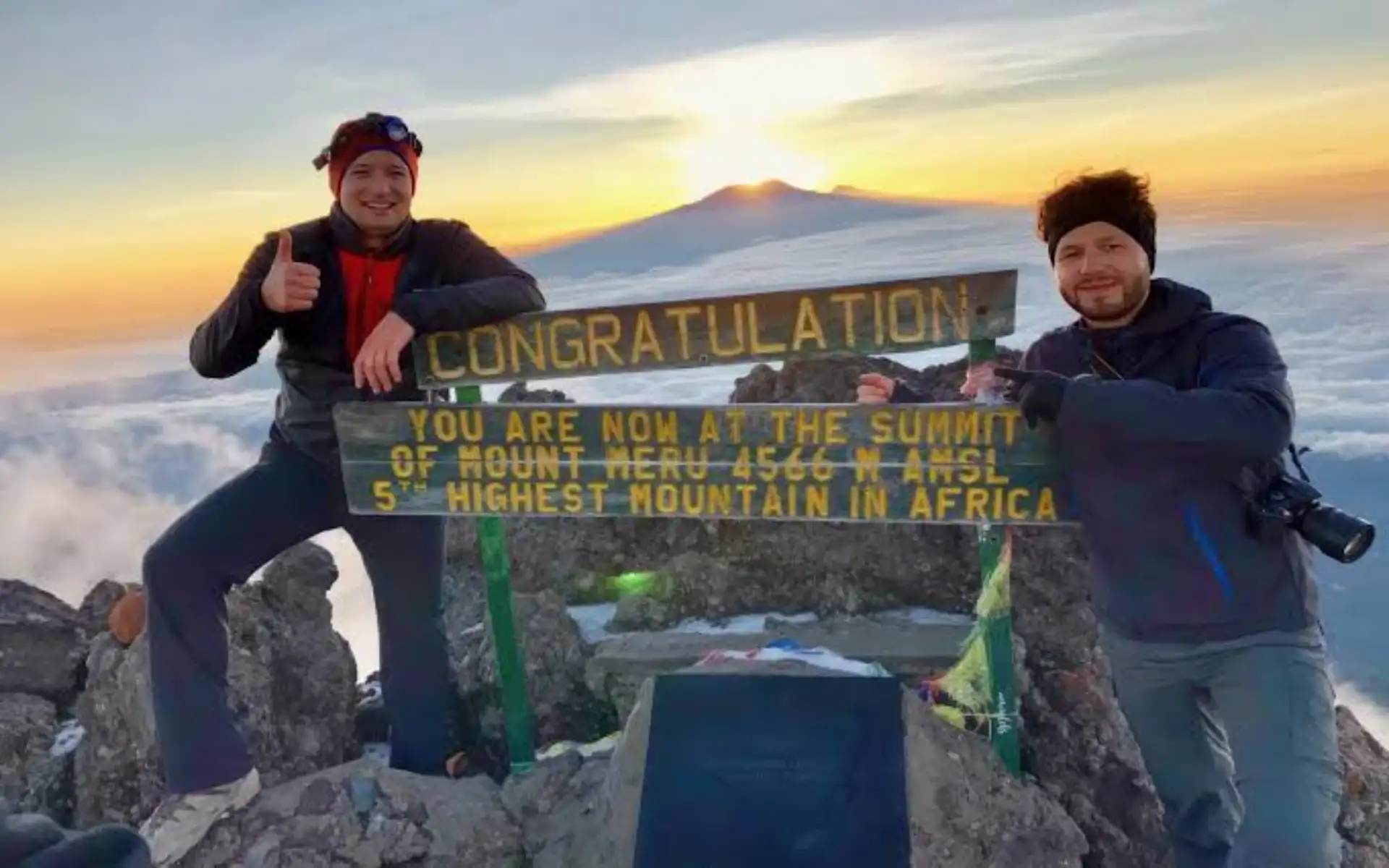
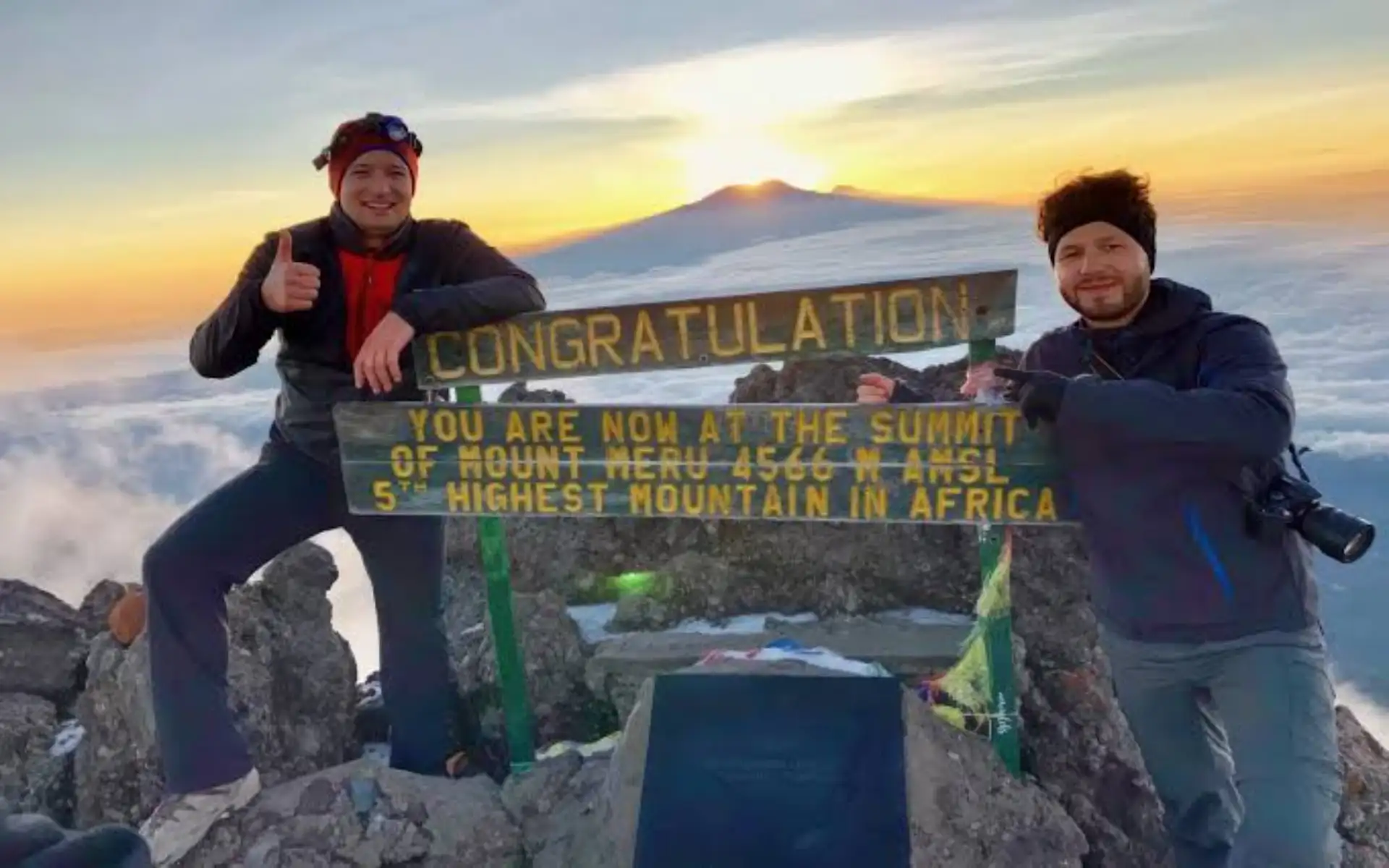
Leave Saddle Hut around 1:00–2:00 am and climb to Rhino Point at about 3,850 m, then follow the exposed crater rim to Socialist Peak at 4,566 m. The summit push can take around 4–5 hours. After sunrise and photos, descend to Saddle Hut, continue to Miriakamba Hut on the 4 day trek, or continue all the way to Momella Gate on the 3 day trek.
Day 4: Miriakamba Hut to Momella Gate
Descend through forest and open parkland to Momella Gate, usually taking about 2–5 hours depending on the descent route. The lower route offers further wildlife viewing and views of Meru’s volcanic ash cone.
If ice, strong wind or poor visibility makes the ridge unsafe, your guide may decide not to continue to the summit. Safety comes before the summit.
Feature | Mount Meru | Mount Kilimanjaro |
|---|---|---|
Summit height | 4,566 m / 14,980 ft | 5,895 m / 19,341 ft |
Typical duration | 3–4 days | 5–9 days |
Route | Momella Route | Several route options |
Accommodation | Mountain huts | Camping on most routes |
Wildlife | High, trek begins in Arusha National Park | Low |
Crowds | Low | Moderate to high |
Best use | Standalone trek or Kilimanjaro acclimatization | Main summit goal |
Meru is not simply an “easy Kilimanjaro.” It is lower and shorter, but the daily elevation gain is significant and the summit ridge is steep, cold and exposed. If Kilimanjaro is your main goal, Meru is one of the best warm up treks because it helps you practise pacing, hydration and summit night routines at altitude.
Mount Meru is a non-technical trek: you do not need ropes, crampons or previous mountaineering experience. The main challenges are altitude, a steep summit ascent and the long summit night, with loose gravel, cold conditions and exposed sections near the crater rim.
A practical fitness benchmark is being able to walk 8–10 km daily and hike roughly 1,000 m of vertical gain in one day. We recommend 6–8 weeks of preparation, including loaded hill walks, stair or incline training, and a medical check if you have heart, lung, blood pressure or other health concerns.
Included:
Not included:
Mount Meru can be climbed year-round, but the clearest and driest conditions are usually in January to early March and June to October. The long rains from March to May can bring mud, cloud and a greater chance that the summit ridge is closed for safety.
You will carry a daypack while porters carry the main expedition duffel. Bring clothing for conditions from roughly 1,500 m to 4,566 m:
Tipping is customary for the guide, armed ranger, cook and porters. As a guideline, budget $20 per day for the guide, $15 per day for the cook and $10 per person per day for each porter. Tips can be given in USD or Tanzanian shillings at the end of the trek.
Many climbers use Meru as an acclimatization trek before Kilimanjaro, resting for a day or two between the two climbs. Others add a Tanzania safari, Zanzibar beach stay, or both after descending.
Tell us your preferred dates and group size, and we’ll help you choose between the 3 day and 4 day Mount Meru treks.
Activity